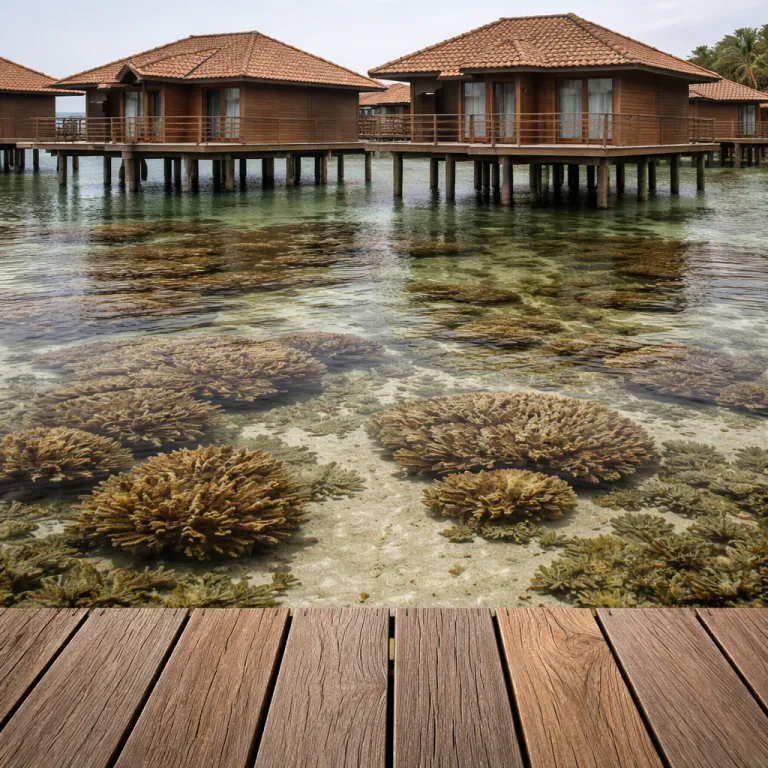
The new measure of luxury: a sustainable overwater villa above a living coral reef
A truly sustainable overwater villa experience now begins long before you arrive. The most serious luxury resorts design the entire structure around the living coral reef rather than on top of it, because the reef and the marine life beneath your deck are the real asset. When you book overwater villas today, the smartest move is to ask how the resort built around the reef, not just how many square metres you get.
Across high end resorts in the Maldives and beyond, sustainability has shifted from a marketing line to a hard business metric. Global data from sources such as Booking.com’s 2023 Sustainable Travel Report and the World Travel & Tourism Council (WTTC) now shows that interest in eco friendly resort stays is rising by double digits, and that trend is strongest where marine conservation and luxury intersect. Booking.com, for example, reports that 76% of travellers want to travel more sustainably and 43% are willing to pay more for certified eco stays, while WTTC’s “Net Zero Roadmap” highlights coastal resorts as priority sites for emissions cuts and nature protection. When you choose a sustainable stay above a coral reef, you are effectively voting for conservation practices that keep your snorkelling ladder busy with parrotfish rather than plastic.
The most advanced projects treat every coral head as a design constraint, not an inconvenience. Architects working on large scale coastal developments, including firms such as Killa Design on the Red Sea giga projects in Saudi Arabia, use eco conscious seabed mapping and non invasive foundations so that coral reefs and seagrass beds remain intact under the villas. Peer reviewed studies in journals such as Ocean & Coastal Management have shown that poorly planned pile driving and dredging can reduce live coral cover by 30–50% within a few hundred metres of construction, while carefully sited structures with limited seabed disturbance have far lower impact. This approach to low impact overwater construction protects the reef, but it also guarantees that guests see marine life from the deck rather than a barren lagoon.
True luxury eco hospitality now means more than a solar panel on the roof. The best resorts integrate renewable energy systems, rainwater harvesting and low impact materials so that the environmental footprint of each stay shrinks while comfort rises. Industry briefings from organisations like the International Renewable Energy Agency (IRENA) suggest that a growing share of island and coastal properties now implement some form of solar energy, and anything less than a serious renewable energy plan should be a red flag for discerning guests.
For business leisure travellers extending a work trip, this shift is especially relevant. You may only have three nights between meetings, so you want a resort where the reef is alive, the marine biologists are on site and the sea is clear enough to reset your senses fast. Choosing hotels and resorts that prioritise reef conservation ensures that your short stay delivers both restorative calm and credible eco tourism impact.
Not every property that markets itself as eco friendly meets that standard. Some overwater villas sit above sandy, lifeless lagoons where the stilts are purely aesthetic and there is no coral reef to justify the premium. When you see glossy images of glass floors, ask whether there are actually coral structures and fish beneath them, or just a carefully framed patch of sea with little to watch once you arrive.
The most reliable indicator is how a resort speaks about its reefs and marine conservation programmes. Look for clear references to reef restoration, partnerships with marine biologists and transparent reporting on environmental impact rather than vague green language. When a resort can explain how guests participate in conservation or eco tourism activities, you are usually looking at a property where sustainability is operational, not ornamental.
For travellers used to urban five star hotels, it helps to reframe what you are paying for. In a city, the value sits in the address and the service choreography, while in an overwater setting the value lies under the waterline. The healthiest reefs, the richest marine life and the most carefully protected barrier reef systems are what justify the nightly rate.
Gili Lankanfushi and the Maldives: where ecological detail shapes the guest experience
Nowhere shows the link between reef health and guest satisfaction more clearly than the Maldives. In the North Malé region, Gili Lankanfushi has become a reference point for how a resort can weave conservation focused thinking into every design decision. This is not a theoretical eco case study; it is a place where you feel the difference the moment you step off the speedboat.
The resort’s overwater villas are built from reclaimed wood and natural fibres, with no unnecessary concrete poured into the lagoon. That material choice, combined with careful siting away from dense coral heads, has allowed the house reef to remain one of the richer reefs in the Maldives, with coral colonies brushing close to villa ladders. When you slide into the sea at dawn, you enter a corridor of marine life that exists precisely because the resort refused to flatten the reef during construction.
Gili Lankanfushi’s approach to reef conservation is unusually granular. Wastewater is treated before it reaches the sea, grey water is reused in irrigation and single use plastics are aggressively phased out to protect the surrounding reefs. The result is a sustainable stay where the environmental systems are invisible to guests, yet every snorkel session over the coral reef is a direct dividend of those backstage decisions.
Marine biologists on staff monitor coral health, lead conservation briefings and guide guests through reef restoration activities. When guests participate in these programmes, such as coral frame planting or monitoring bleaching events, they gain a sharper understanding of how fragile the reef ecosystem is. That knowledge tends to travel home with them, influencing future travel choices and raising expectations for eco conscious standards at other resorts.
The Malé Atoll context also matters for pricing and value. Resorts with vibrant house reefs, like Gili Lankanfushi, can justify higher rates because the snorkelling and diving accessible directly from the villas rival paid excursions elsewhere. In contrast, properties in North Malé that sit above degraded reefs or sandy lagoons often rely on boat trips to distant barrier reef sites, adding both cost and environmental impact to each stay.
For travellers who appreciate refined urban hospitality, it can help to benchmark against a city property. The carefully curated service and design at a place such as the TwentySeven Hotel in Amsterdam, reviewed in depth in our guide to the refined luxury of a junior suite stay, mirrors the attention to detail you should expect from a Maldivian resort claiming to be luxury eco. The difference is that, in the Maldives, that same level of precision must extend to how the resort treats its reef, its waste streams and its energy use.
Across the archipelago, the Ministry of Tourism and Environment is signalling stricter environmental standards for new resorts. Green Globe style certifications and national labels are fast becoming table stakes rather than differentiators, especially for overwater villas built near sensitive coral reefs. For guests, this regulatory push means that asking about certifications, reef monitoring and renewable energy use is no longer niche behaviour; it is simply due diligence before you commit to a high value stay.
From a guest experience perspective, the difference between an eco friendly marketing claim and a truly sustainable tourism operation is obvious once you are on the deck. In a well managed resort, the sea below your villa is busy with reef fish, rays and sometimes turtles, and the water remains clear even after heavy occupancy. In less careful hotels, you may notice algal blooms, sediment clouds and a surprising absence of life around the stilts, all signs that the coral and the wider reef system are under stress.
Designing around the reef: from the Red Sea to private islands
The most interesting low impact overwater projects now sit far beyond the classic Maldivian postcard. In the Red Sea, Killa Design is involved in overwater and coastal villas within Saudi Arabia’s regenerative tourism developments, using eco friendly construction techniques that treat every coral head as a protected asset. Their brief is clear: preserve marine ecosystems, utilise renewable energy sources and offer luxury accommodations sustainably.
That means mapping coral reefs and seagrass beds in detail before a single pile is driven into the sea. Non invasive foundations, elevated walkways and careful spacing between villas allow water to flow naturally, reducing sediment build up on the reef and keeping marine life patterns intact. When resorts respect these environmental dynamics, guests later enjoy clearer water, healthier coral and more engaging snorkelling directly from their decks.
On private island developments, the temptation to overbuild is strong because every additional villa seems like extra revenue. Yet data from eco tourism partners in destinations such as Cairns, highlighted in our feature on luxury accommodations that support eco conscious travel, shows that properties with intact reefs and strong marine conservation programmes achieve higher occupancy at better rates. In other words, protecting the barrier reef and surrounding coral gardens is not charity; it is a revenue strategy.
Designers who specialise in conservation driven projects now talk about “reef carrying capacity” in the same way urban planners discuss traffic flow. There is a limit to how many overwater villas a lagoon can support before the cumulative impact on the reef becomes visible in coral bleaching, fish migration and water clarity. Guests may not use that vocabulary, but they feel the difference when a lagoon is overcrowded with structures and the sea beneath their villa feels strangely empty.
Energy systems are another quiet frontier of sustainable stays. Resorts that invest in large scale solar arrays, efficient desalination and smart cooling systems reduce both operating costs and environmental impact over time. Industry case studies from WTTC and IRENA indicate that renewable energy adoption in island resorts is accelerating, and the most forward looking properties are already pushing beyond basic solar panels with integrated renewable energy microgrids.
For travellers, the practical question is how to read between the lines of a resort’s sustainability page. Look for specific references to reef conservation, named marine biologists on staff and measurable eco tourism initiatives rather than generic eco friendly language. When a resort explains how guests participate in monitoring programmes, coral planting or guided educational snorkels, you can be more confident that the sustainable tourism narrative is grounded in real action.
Partnerships with local environmental agencies and sustainable tourism organisations are another strong signal. These collaborations often bring rigorous monitoring, transparent reporting and access to scientific expertise that a single resort could not maintain alone. When you see this level of engagement, you are usually looking at a property where the commitment to protecting the reef is embedded in the business model, not just in the brochure.
How to book smarter: reading the reef before you reserve
For business leisure travellers, time is the rarest luxury. You may be flying into the Maldives or another reef rich region for meetings, then tacking on a few days of rest, so every hour of your stay needs to count. Choosing an overwater villa above a thriving coral reef is the most reliable way to ensure that your short break feels both indulgent and meaningful.
Start by interrogating the images and language on the resort’s website. If every photograph of overwater villas shows turquoise water but no visible coral structures or reef fish, assume the lagoon may be more sand than reef. Ask the reservations team directly about the house reef, the distance from your villa ladder to the nearest coral and whether marine biologists are present on site.
Next, look for evidence of structured marine conservation programmes and broader environmental management. A serious resort will be able to explain how it handles reef restoration, waste management and water treatment in clear, specific terms. As one sustainability briefing from the Global Sustainable Tourism Council (GSTC) puts it, “What makes an overwater villa sustainable? Use of renewable energy, sustainable materials, and minimal environmental impact designs.”
Guest facing activities are another filter. Properties that invite guests to participate in reef conservation, such as coral frame sponsorships or guided eco tourism snorkels, tend to have deeper environmental commitments behind the scenes. When guests participate in these programmes, they become informal ambassadors for sustainable tourism, carrying those expectations to future hotels and resorts they book.
Pricing can also be a clue rather than a deterrent. Resorts with thriving reefs and strong conservation credentials often command higher nightly rates, but they offset that with world class snorkelling and diving included just steps from your bed. You are not paying only for square metres and thread count; you are paying for immediate access to a living reef that has been protected rather than sacrificed during construction.
For travellers who appreciate thoughtful urban hospitality, it can help to think of reef health as the overwater equivalent of a prime city address. Our review of the elegant stays that inspire luxury overwater villa bookings makes the same point; location and context define the experience as much as the room itself. In an overwater setting, that context is the coral reef, the clarity of the sea and the integrity of the surrounding marine ecosystem.
Finally, consider how your own behaviour can align with the eco conscious ethos you are seeking. Choose reef safe sunscreen, avoid touching coral or standing on reefs and follow local guidelines from marine biologists and guides. When you combine a carefully chosen resort with respectful personal habits, your stay becomes part of a broader shift towards genuinely sustainable stays rather than just another line in a marketing brochure.
Key figures shaping sustainable overwater villa coral reef travel
- According to the World Travel & Tourism Council’s “A Net Zero Roadmap for Travel & Tourism” (2021) and IRENA’s renewable energy outlooks, a growing proportion of island and coastal resorts now implement some form of solar energy, signalling that renewable power has moved from niche experiment to mainstream expectation in luxury eco resorts.
- Booking.com’s 2023 Sustainable Travel Report notes that 76% of surveyed travellers want to travel more sustainably and that a significant share actively seeks eco friendly resorts, showing that guests are increasingly rewarding hotels and resorts that invest in conservation focused practices and credible marine conservation programmes.
- Industry surveys across multiple reef destinations, including analyses cited by the Global Sustainable Tourism Council and Green Globe, highlight a strong correlation between healthy house reefs and higher average daily rates, confirming that protecting coral reefs and nearby barrier reef systems directly enhances both guest satisfaction and long term revenue.
trustful_expert_quotes: Booking.com 2023 Sustainable Travel Report; World Travel & Tourism Council, “A Net Zero Roadmap for Travel & Tourism” 2021; International Renewable Energy Agency (IRENA); Global Sustainable Tourism Council; Green Globe; Ocean & Coastal Management